Sunday, December 4, 2022

Digital Fabrication Midterm

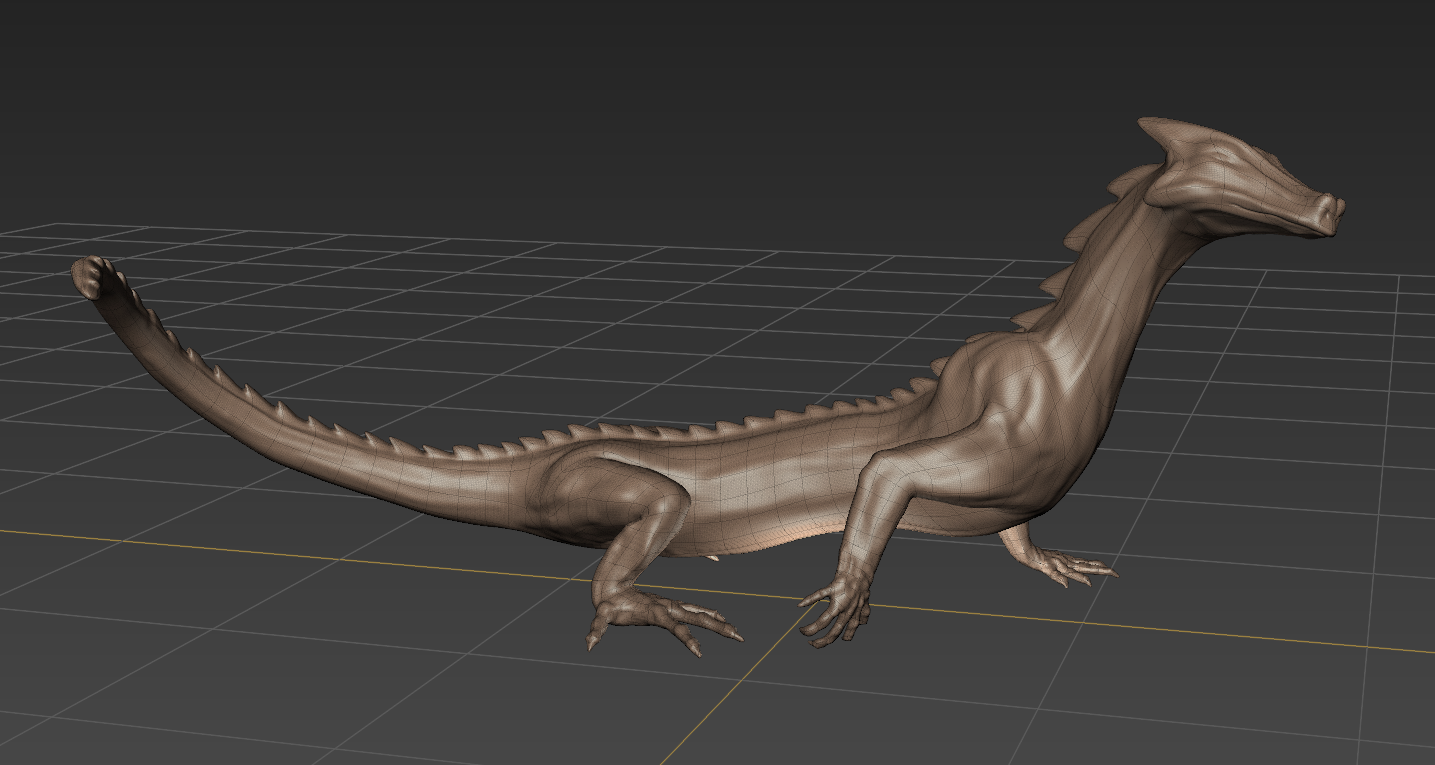
 I’ve always been very inspired by Dungeons and Dragons and the high fantasy setting that is often associated with the table top role play game. Early on in this semester I knew that I wanted to model a creature inspired by the D&D 5th edition Monster Manual and was drawn to the fairy dragon, a small mischievous dragon with a slender, muscular body and delicate butterfly wings. Initially I had modeled the full body of a dragon inspired by the 5th edition creature and upon further critique I focused on just the head for my 3D print. Once my model was properly prepped using Mudbox and Rhino, I created my silicone mold and started casting. 
The concept for my two midterm compositions was inspired by two initial concepts. The first was incorporating the sculpting method of adding and subtracting from my dragon head. For one composition I would add some type of textile and for the other I would to focus on subtracting by using a dermal to carve away the plastic. The second inspiration was tied to my studies on mental health and psychiatric disabilities. As I started working on this project, I found myself listening to a song called "Bones in the Ocean" by The Longest Johns. The song focuses on the survivors guilt of a sailor and considering dragon's mythological ties to the ocean I wanted to focus on the concept of visually representing trauma using my dragon heads as a canvas. Trauma is often categorized into three main types: acute, chronic, and complex. For these two sculptures I would focus on acute and chronic trauma.

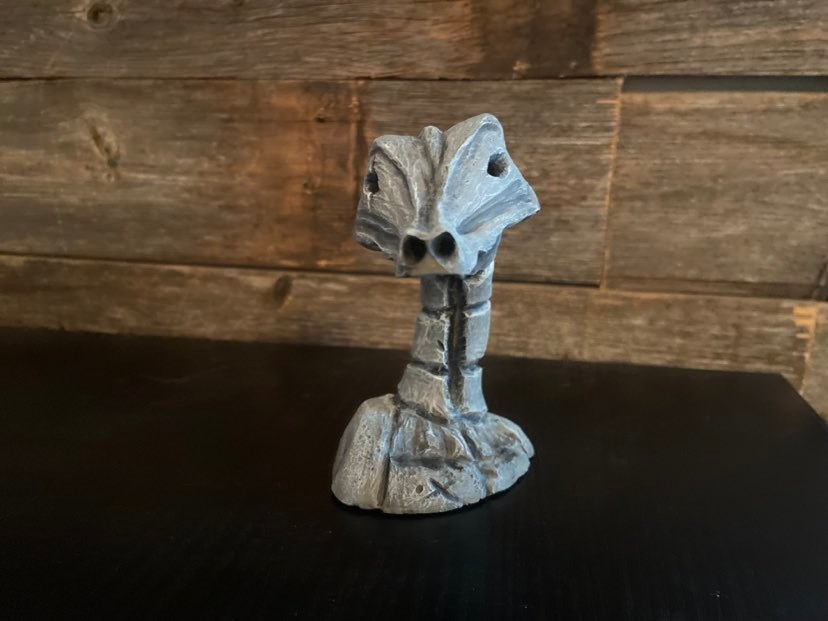
The first composition I sculpted is “Skull”, a stylized carving of a dragon’s skeleton. After casting my dragon head, I used a dremel to carve away the casting material. I used artist renderings of dragon skeletons along side images of snake, alligator, and other reptilian skeletons as reference. The carving process took approximately six hours to complete. As I carved I did not want to sacrifice the structural integrity of the sculpture which resulted in a more stylized version of the skeleton. I then added details such as the scars along the dragon’s neck and skull. I wanted to use this sculpture to represent acute trauma (trauma that results from a single event). To convey this I wanted to use the scars to symbolize that this creature had fought in battle of some kind. After the carving process was complete I painted a base coat of a tan camo spray paint. When the base coat was dry, I used watered down black acrylic paint to add shadows followed by a dry brush of white-green acrylic paint to bring out the highlights.

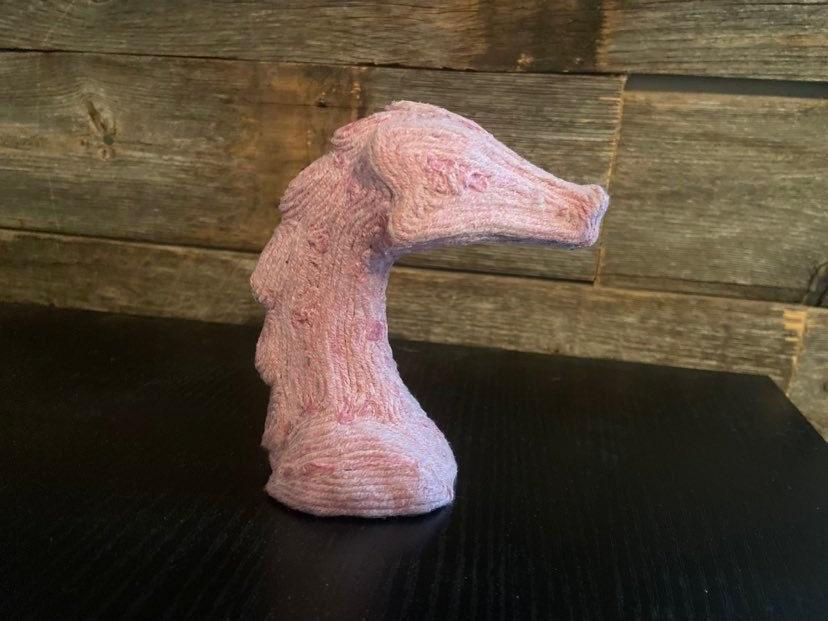
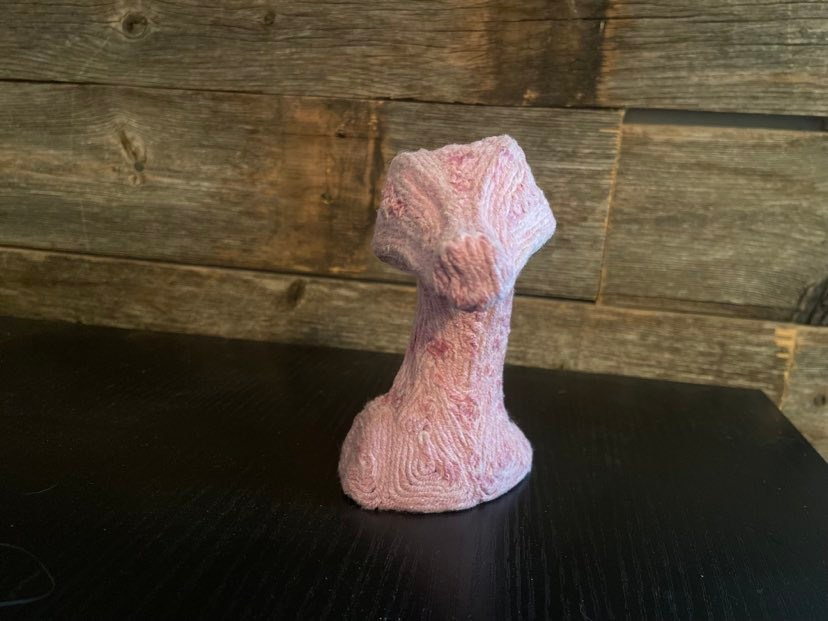
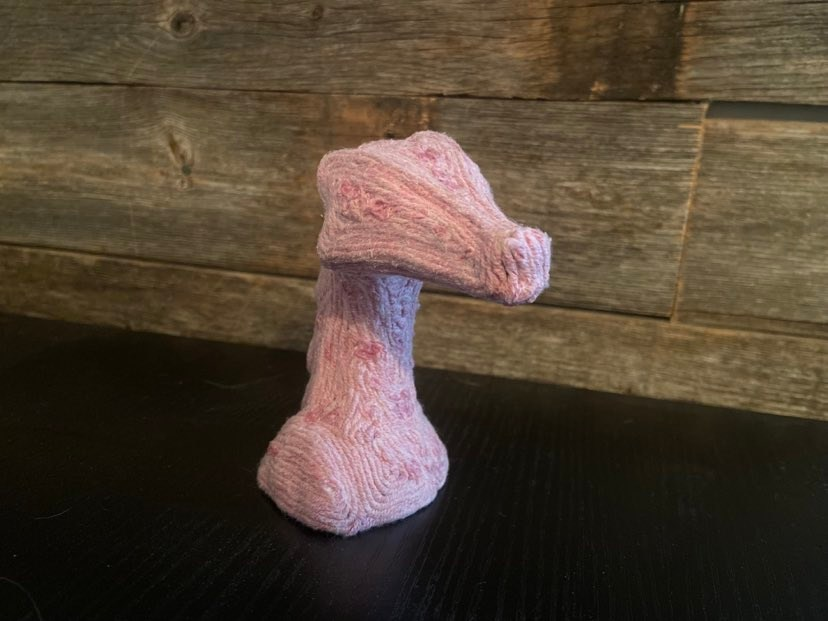
For my second composition I created “Meat Slab”, a dragon’s head using yarn to convey the concept of a muscular system. This second composition was very much an example of material choices informing the concept of the composition. I had lavender yarn left from a previous crocheting project and I thought it would be interesting to add a textile to the dragon head using tacky glue . Using a white color pencil I drew on the divisions of muscle groups onto the dragon’s head to serve as a guide. I was planning to use various shades of purple yarn and color block the various muscle groups. After experimenting with attaching the other yarns to the dragon head, I found that this lavender yarn adhered the best. The gluing process took approximately seven hours. This sculpture is mean to represent chronic trauma (trauma that results from prolonged abuse or exposure to negative events). In the yarn I added patches of concentrated yarn to symbolize the various abuse the dragon could have experienced. I considered using embroidery thread to add additional detail but I was very drawn to the monochromatic look and chose to not add any additional details. In the end the sculpture look a lot more like ground meat, and in addition to its ties to chronic trauma, is why the piece is titled “Meat Slab”. 

For my midterm I created two compositions experimenting with additive and subtractive techniques using my original dragon head sculpture. Both “Skull” and “Meat Slap” are representative of different forms of trauma.


"Skull"


"Meat Slab"


Saturday, December 3, 2022

Lovely Monster

 Reducing the polygone to 150 in Rhino.


Open the file in Pepakura and cut it in pieces to fit in cardboard sheet. Cut them with lasercut and glue them together, and tape them and the end. 


Pleasant experience

For this work I sliced my model in Rhino and Grasshopper. Then laser cut them on cardboard sheet. 


Put all layer together and glue them with super glue professional. 


Then covered the whole piece with masking tape, then coat it with sculpting epoxy. Finally I painted it and sanded it.


My first sculpture ever

 I started to make my model in Mudbox, then transfer it to the Rhino and made it ready for 3D print.


After I got the 3D print I made a Mold out of Reboud 25, then I doublicated my model out of Onyx Fast.


At the end I made some composition with adding other material to my model to make it meaningful for myself.


Tuesday, October 11, 2022

Wood Lorin: Weeks 1-3 Deacon


This was the initial sculpt which was executed on my iPad in the application Nomad. I was more interested in interesting forms than a coherent, aesthetically pleasing design. As with all of my art, it was not finished so I continued to refine the shapes into the following final sculpt. I called it the "deacon" due to its semi-religious shape.

(export from Nomad)

(Marmoset Toolbag render)

Monday, October 10, 2022

Grace Denner: Week 8 Tree Stump


Grace Denner: Week 8 Tree Stump 


The Model:


In the popular tabletop role-playing game Dungeons and Dragons (D&D), a mimic is an amorphous creature with the ability to assume the shape of seemingly harmless objects. My desire to create some sort of mimic and play with natural textures led me to make the Tree Stump Mimic, the model for the rest of my compositions. The model was created in Mudbox, refined in Rhino, scaled in Maya, and printed out using Grey PLA filament.


Composition 1:


My idea was to treat this like one would treat any D&D miniature and leave it as a solid material that I’d paint over afterward. This plan, however, did not play out as intended. While preparing my first pour, I used Smooth-Cast™ ONYX™ FAST resin and only had about 60 seconds from the initial mix to when the resin solidified, and I stirred the mixture for too long. As I poured, the liquid became suddenly solid towards the end. This semi-solid pour resulted in a half-poured mold with a stable but fluid-looking fold protruding from the mold.


With no other choice, I let the cast dry and waited to see what it would look like out of the mold. What resulted was an exciting “moment in time” piece that, to me, captured the art of the pour. I decided then to roll with it, not only because of how expensive the materials were and how much I didn’t want to have to buy more but because I knew if I could tweak the piece just a bit, it would turn into something incredibly unique. 


I set out afterward to use the rest of my resin to cast the mixing cup itself, stirring and then rotating the cup at an angle to coat the cup and have the resin harden in the motion of being poured out of it. I was attempting to repeat my first mistake because despite the saying “two wrongs don't make a right,” I was determined to make them work.


After this, I used epoxy resin clay to attach the two pieces, let them dry, and painted the clay black.


The hardest part of this sculpture was figuring out how to mount it. I had this vision of suspending it in mid-air but struggled to find anything that would support its weight. I ended up drilling a hole into the bottom and supported the sculpture underneath using an acrylic rod. For the base, I carved and rounded the edged of a wooden board, drilled a similar hole, and stained and coated it with polyurethane to give it a simple yet clean look.


The process of creating this first composition was all about embracing my mistakes. I’ve never done anything like this before. I’ve never done 3D modeling, 3D printing, mold making, etc., and I made many mistakes. However, I worked with these mistakes, built upon them, and turned them into a piece I am proud to have made. This piece captures the art of the pour in casting and celebrates the movement and life that can come from the process.


Composition 2:


For my second composition, I knew I needed to get the casting right, and I practiced the timing a few times to get a consistent cast. When I had a feel for that, I went ahead and started figuring out my next sculpture. I knew I wanted to use some pigment this time around and wanted to make the eye of the stump pop as it blended into the rest of the figure a bit too much for my liking. With this in mind, I dusted the eye along with the mushrooms protruding out the sides of the trunk with a strong gold pigment, then mixed some more pigment into the resin. This mix resulted in a black trunk with gold accents. 


After removing the cast from the mold, I was unsure of the direction I wanted to go in with the trunk. It was pretty but lacking. Even with the gold accents, it felt like it was plain. Then I pulled out the leftover resin from the mixing cup. It was this beautifully ethereal mix of black and gold in the shape of an open circle. Jokingly I placed it on the trunk as the halos people see in classical paintings of saints. The fluid swirls of pigment perfectly complimented the static nature of the trunk; the halo almost seemed to move. I stuck the halo in place with more epoxy clay, let it dry, and painted it over with black, blending the paint up into the halo.


Neither of these compositions ended how I originally envisioned them. I imagined using textured paints to emphasize the bark, maybe adding some moss, and painting over the eye to make it bloodshot. These compositions became what they are now by taking my time, seeing each step as it happened, and figuring out how to use what I had to make something interesting. This was a learning process for me, full of experimentation, going with the flow, and using mistakes and scraps to make something beautiful.